Showing posts with label cows. Show all posts
Showing posts with label cows. Show all posts
Wednesday, February 5, 2014

Tuesday, March 19, 2013
Celebrating Nat'l Ag Day With Milk
 Today is National Ag Day! We're proud we get to get up and milk our cows everyday and provide wholesome nutritious dairy products for people to enjoy.
Not everyone can have the opportunity to grow up on a farm and we want to make the most of it. To quote a phrase from our area dairy organization, SUDIA, we are dedicated to dairy; our cows, our milk, and our land. And there's no better day to celebrate that than today!
So pour yourself a glass of milk, make a bowl of ice cream, or a slice yourself some cheese and toast the joy of dairy farmers on Ag Day!
Thursday, November 8, 2012
Learn How To Be A Dairy Farmer Over Lunch
I've often said if they, whoever they are, had just come to me first I could've told them how they should have done the thing they were doing. That's probably a lot of big talk and the line to my door asking for my advice has been very short indeed. This week there actually was somebody knocking and I hope the advice I gave was somewhat helpful.
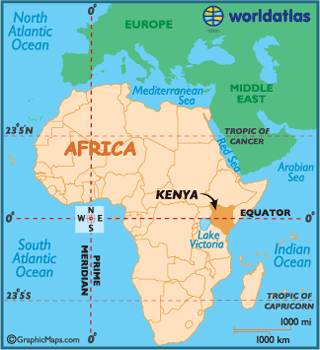 This began with a phone call from my county extension agent who asked me to meet him for lunch. Some folks had contacted him about a missionary from Kenya who wanted to know about dairy farming who I will refer to as "Ken." So, being totally motivated by the offer of french fries and a barbecue sandwich I made plans to go.
The lunch meeting consisted of my extension agent and one of his friends, Ken, and two men with the organization that are helping Ken to meet people to learn about dairy farming. Maybe I should preface the rest by saying everything I know about dairy and agriculture in Kenya I learned from Ken.
Ken continued by talking about how he needed to get registered cattle (meaning certified by a breed organization) and how it would take a few generations to do that. I spoke up at this point to let him know that my dairy cows are not registered and don't need to be. I sell milk and healthy strong cows that make milk are all I need and I suggested that might be a simpler approach for him to take.
He went on to describe how each family's goal would be to have up to a dozen cattle to milk. We then began asking him about breeding the animals because I reminded him that cows have to have a dry period of no milking while they are pregnant and if they are never bred they will eventually stop producing milk. Ken wasn't aware of that and perhaps that was the first clue I had of how big a hill he was trying to climb. I offered that the families could buy/rent a community bull to service all the animals as needed. A simple approach, I hoped.
Ken was excited to meet and talk with us and get more questions answered. The best suggestion the group gave him was to work on a dairy for at least a week, if not a season or so. Hands on training with animals and milking is probably the best way to understand how to do it. Unfortunately Ken had to return to Kenya almost immediately. I told him something I would never imagined myself saying just a few years ago: go look on YouTube. You can find examples of practically anything on dairy farming there from milking to forage production. It wasn't a perfect solution, but in this case I hoped it would be of some use.
map
This began with a phone call from my county extension agent who asked me to meet him for lunch. Some folks had contacted him about a missionary from Kenya who wanted to know about dairy farming who I will refer to as "Ken." So, being totally motivated by the offer of french fries and a barbecue sandwich I made plans to go.The lunch meeting consisted of my extension agent and one of his friends, Ken, and two men with the organization that are helping Ken to meet people to learn about dairy farming. Maybe I should preface the rest by saying everything I know about dairy and agriculture in Kenya I learned from Ken.
Teach A Man To Fish Equals Teach A Man To Milk?
Ken began explaining how he was college educated in what he called something like community outreach. He wanted to learn how to milk and care for dairy cattle and then teach that to the people in his community. They could then sell that milk and improve their lot in life. That sounded inspirational and like a huge project.Ken continued by talking about how he needed to get registered cattle (meaning certified by a breed organization) and how it would take a few generations to do that. I spoke up at this point to let him know that my dairy cows are not registered and don't need to be. I sell milk and healthy strong cows that make milk are all I need and I suggested that might be a simpler approach for him to take.
He went on to describe how each family's goal would be to have up to a dozen cattle to milk. We then began asking him about breeding the animals because I reminded him that cows have to have a dry period of no milking while they are pregnant and if they are never bred they will eventually stop producing milk. Ken wasn't aware of that and perhaps that was the first clue I had of how big a hill he was trying to climb. I offered that the families could buy/rent a community bull to service all the animals as needed. A simple approach, I hoped.
Feed and Milk Processing
We asked Ken about available feed for the animals. He said that Kenya was in a warm climate and that he had been feeding his one cow and calf dried corn husks and some other plant from what I gathered was a grocery type store. He also picked leaves from a native plant. When we inquired how the community would feed their animals he said the children could pick leaves so they could do their part. Wow, that was going to be many leaves to keep just one animal going. Cows need lots of feed and forages in a well balanced diet to produce milk. Without good nutrition they are not going to make much at all. We suggested that some families might earn their money by growing and harvesting crops for the animals.
When asked about processing the milk Ken said there was a processing plant nearby that you could take your milk to and they would pasteurize it and give you a portion of it for yourself to drink and a small price for what you sold them. Questions we thought he should ponder were how to get the milk there in bulk quantities as well as how to ensure food safety when in storage and transport.
Man on a Mission
 |
| Sunset in Kenya |
Will he be able to implement his dream of helping his community by teaching them how to care for dairy cattle and become dairy farmers? I don't know. Did I teach him how to be a dairy farmer over lunch? Definitely not. He's got a very long row to hoe, but I think he really wants to make a difference and I wish him well on his pursuit.
map
Friday, June 1, 2012
Happy June Dairy Month!

Last night I picked up my daughter from dance practice and when she asked for something to drink I handed her the chocolate milk I had picked up for her on the way. "Does this come from magic brown cows?" she asked jokingly. "No," I replied, "this is regular milk from regular cows."
But maybe saying it is regular milk is wrong. Maybe I should say it is extraordinary milk from extraordinary cows. Milk is packed with nine essential vitamins and minerals which makes it a great nutrient rich food. With all the wonderful dairy products that start with it there's no way to describe it as ordinary.
The cows and I wish you a Happy June Dairy Month!
Be sure to celebrate with milk, cheese, ice cream,
and all your other favorite dairy products!
Wednesday, May 30, 2012
Thursday, January 12, 2012
Are There Snow Days on Dairy Farms?
There's just one reason that my kids perk up and want to actually watch the news. It is when they hear the magic word: snow. Or as they say in White Christmas:
So when the news of possible snow arriving tonight was mentioned they have been very excited about the chance of missing school. I'm sure they'll use their guaranteed method of wearing their pajamas inside out to make sure they get some of the white stuff on the ground.
But what about dear old dad? No, there's no snow days for dairy farmers. The cows have to be fed and milked just like any other day. Bad weather of any kind just makes our chores a little harder. We usually have to cut back on any extra things we might want to do in order for us to have time to make sure the cows and calves have plenty of water and feed. We have a generator in case the power goes out so we can still milk the cows twice a day and feed.
Here's a video from a few years ago where we were out feeding a round bale of hay to our pregnant cows after a small snow.
So when the news of possible snow arriving tonight was mentioned they have been very excited about the chance of missing school. I'm sure they'll use their guaranteed method of wearing their pajamas inside out to make sure they get some of the white stuff on the ground.
But what about dear old dad? No, there's no snow days for dairy farmers. The cows have to be fed and milked just like any other day. Bad weather of any kind just makes our chores a little harder. We usually have to cut back on any extra things we might want to do in order for us to have time to make sure the cows and calves have plenty of water and feed. We have a generator in case the power goes out so we can still milk the cows twice a day and feed.
Here's a video from a few years ago where we were out feeding a round bale of hay to our pregnant cows after a small snow.
Wednesday, December 21, 2011
Dairy Farming and Christmas
There's no doubt that Christmas is a busy time. Family gatherings, parties, church services, shopping for presents, and all the other things we do make it a little chaotic around the house. For dairy farmers there is one constant thing and that is milking time.
Everything, including Christmas, in some way revolves around the cows. What we do and when we do it has to be before or after milking and feeding. That's just part of dairy farming. So if we arrive a little late to something it is only because we wanted the "girls" to be well fed and taken care of.

But the big question most folks want to know is do cows celebrate Christmas? I'll let you judge for yourself, but I will add that they did decorate with some lights again this year.
Everything, including Christmas, in some way revolves around the cows. What we do and when we do it has to be before or after milking and feeding. That's just part of dairy farming. So if we arrive a little late to something it is only because we wanted the "girls" to be well fed and taken care of.

But the big question most folks want to know is do cows celebrate Christmas? I'll let you judge for yourself, but I will add that they did decorate with some lights again this year.
Tuesday, December 6, 2011
From Moo to You: Milking the Cows
While you can buy milk at the grocery store it does not appear there magically. Milk comes from cows on dairy farms, many of which are just like mine.
Our cows are milked two times a day; once early in the morning and once in the mid-afternoon. After they've had some hay and silage to eat we walk them to the holding area behind the dairy barn. The cows waiting to be milked stay there and those that have been milked can then walk back out to the feeding areas.
The cows enter the barn five at a time on one side. While one group is being milked the other side is being prepped for milking. The milkers are then put on the cow and the milk flows through the hoses and into the pipeline.
From there the it goes into our milk tank for storage. The milk is stirred and kept cold until the milk truck comes to pick it up and take it to a processing plant. Then it is bottled or made into other delicious dairy treats. All of our equipment is washed after each milking. The tank is also cleaned after each pick up.

After being milked the cows have hay and fresh silage waiting on them to eat. Then they are free to roam out on the pasture field until the next milking.
Our cows are milked two times a day; once early in the morning and once in the mid-afternoon. After they've had some hay and silage to eat we walk them to the holding area behind the dairy barn. The cows waiting to be milked stay there and those that have been milked can then walk back out to the feeding areas.
The cows enter the barn five at a time on one side. While one group is being milked the other side is being prepped for milking. The milkers are then put on the cow and the milk flows through the hoses and into the pipeline.
From there the it goes into our milk tank for storage. The milk is stirred and kept cold until the milk truck comes to pick it up and take it to a processing plant. Then it is bottled or made into other delicious dairy treats. All of our equipment is washed after each milking. The tank is also cleaned after each pick up.

After being milked the cows have hay and fresh silage waiting on them to eat. Then they are free to roam out on the pasture field until the next milking.
Thursday, June 16, 2011
Good Things Come in Time
The first thing I noticed this morning when I entered the calf barn was that one of the new calves had eaten all of her grain last night for the first time. Yesterday she had eaten her hay that I had put in her manger for the first time as well. Seeing progress like that is one of the things that makes being a dairy farmer rewarding.
After 15 straight days of 95 degree temps and blazing sunshine we've finally had a cold front move in bringing our highs down to 85. It has made a big difference to me and I know it has to the cows. These long hot days are stressful on them and we had seen some reduction in milk production. The last two days the cows have all come in to be milked on their own from out of the fields for the morning milking. They have also begun eating more hay and silage. When the cows are comfortable and happy you can bet on better milk production.
We also finally got rain today. While it has been easy to put up hay when it never rains it has been hard to look at our corn in the afternoons. In the morning the corn looks nice and green but by the time the sun burns down on it later you can see the leaves twist and stretch to the sky aching for a few drops. Already we've got an inch over the course of several hours which has to be good.
After 15 straight days of 95 degree temps and blazing sunshine we've finally had a cold front move in bringing our highs down to 85. It has made a big difference to me and I know it has to the cows. These long hot days are stressful on them and we had seen some reduction in milk production. The last two days the cows have all come in to be milked on their own from out of the fields for the morning milking. They have also begun eating more hay and silage. When the cows are comfortable and happy you can bet on better milk production.
We also finally got rain today. While it has been easy to put up hay when it never rains it has been hard to look at our corn in the afternoons. In the morning the corn looks nice and green but by the time the sun burns down on it later you can see the leaves twist and stretch to the sky aching for a few drops. Already we've got an inch over the course of several hours which has to be good.
Monday, June 6, 2011
Harvesting
After practically running out of hay and silage over the winter things are finally starting to look up around here on the farm. It really got cold early last year and we had to start feeding more of both to the cows to keep them healthy. The colder the weather the more they needed to eat and boy did they eat a lot.
Last week we finished chopping all of our spring crop. We had wheat and rye mixed in a few fields and ryegrass and marshall ryegrass in a few others. We try to raise a few different types so that in spite of weather stresses on one type the other might grow well.
This is a video of the silo unloader, which is raised to the top of the silo during filling, is being lowered down on a cable to the silage. One of the worst parts about getting silos ready to feed off of is making sure the silage is level all the way across, in this case that is twenty feet. This time we got lucky and there was very little forking to do in the silo to level it up.
We've also got our first field of hay mowed and hauled in. What a great feeling to know that we have hay and silage ready for our cows to eat to make tasty fresh milk.

Last week we finished chopping all of our spring crop. We had wheat and rye mixed in a few fields and ryegrass and marshall ryegrass in a few others. We try to raise a few different types so that in spite of weather stresses on one type the other might grow well.
We've also got our first field of hay mowed and hauled in. What a great feeling to know that we have hay and silage ready for our cows to eat to make tasty fresh milk.

Wednesday, June 1, 2011
June is Dairy Month!
 June is dairy month! Woo-hoo! (You can't see it but this is the part where I'm jumping up and down.) Imagine having your birthday celebrated everyday for a month, that is what June is like for a dairy farmer. All over the country for a whole month people will be talking about dairy farmers and dairy products.
 There's a lot to love about dairy. From milk to ice cream, all types of cheeses, butter, and don't forget yogurt because I know if I forgot to buy yogurt my girls would be upset! The cows, too, there's a lot to like about the cows out there producing nature's most perfect food. Look at them there eating hay and getting ready to go be milked. That is dairy delight!
So be sure to celebrate June dairy month and support the cows, farmers, and everyone else down the line that brings delicious dairy products to you!
Monday, May 16, 2011
Farmer Jed Syndrome

A recent article in the American Farm Bureau newspaper made me think about what I call the "Farmer Jed Syndrome." The report was on a survey by the Kentucky Farm Bureau that revealed out of 551 shoppers at farmers markets 54% said that farming is worse than in the past and cited factory farms and the loss of the family farms as contributing factors. The Ky FB president, Mark Haney, went on to say that "people in general are unaware that family farms account for more than 90% of our farms."
The Farmer Jed Syndrome is how I describe the disassociation of the consumer to their food. I think many people have the idea that agriculture should look just like Farmer Jed in a Little People playset, no different than Dorothy's family farm in The Wizard of Oz.
 |
| Toto, we're not in the 1930's anymore
Just like the cell phone you carry today is much more sophisticated than the large bag type cell phone that was carried twenty years ago, farming technology has changed. Today through innovations in nutrition we can feed cattle a balanced ration through each stage of their growth and production. Their health and milk production can be monitored with computers to better evaluate their status (a great video example of this in action on a dairy farm). Studies from ag extension services have helped us better understand cattle handling techniques and housing. Vaccines are now common place to keep our animals healthy. Advances in genetics have helped eradicate unhealthy traits in cattle and improve on good ones. The farmer of today produces twice as much as the previous generation and uses less land, water, and energy. Dairy farming has changed a lot since Dorothy went to Oz.
|
I've always thought of our farm as a small family farm. I'm often asked how many cows do we milk. When I reply around 100 they usually reply with that's a lot. I've never thought it was especially when I compare myself to some neighboring farmers who milk several hundred. Another farmer with less than fifty head of cattle might think I'm big. No matter what size a farm is there is one thing they all do the same and that is care for their animals. If that farmer with thirty cows doesn't pay attention to them and treat them well he won't be farming long and that is no different for the big dairy. Making sure the animals are healthy and happy will make them productive and that is the goal of every dairyman.
"The rule to be observed in this stable at all times, toward the cattle, young and old, is that of patience and kindness. .......Remember that this is the Home of Mothers. Treat each cow as a Mother should be treated. The giving of milk is a function of Motherhood; rough treatment lessens the flow. That injures me as well as the cow. Always keep these ideas in mind in dealing with my cattle."--William Dempster Hoard
Wednesday, April 13, 2011
Hats

Some of us have a lot of hats that we wear. Mine, in no particular order, include father, husband, son, friend, farmer, and a few more. Wearing the right hat at the right time is not always an easy task. While many people can indentify with some hats I wear there are less than 2% of the population that wear a farmer hat like me.
I went to town to do some non-farm business the other day and as usual I was wearing a farm hat and coat. While waiting on some paperwork the sales clerk began asking about what kind of farming I do and reminiscing about her own childhood farm memories. Unfortantly for me I was focused only on me and missed a great opportunity to spread the good news about milk. I forgot my hat. A few days later I was again in town and fell into the same situation. This time I was pro-active and talked about dairy farming and the ways we provide safe wholesome milk with happy healthy cows. I was proud of the hat I was wearing.
Tuesday, February 15, 2011
Not Just A Number

Our cows wear a number, but that does not make them just a number. We don't have a philosophical reason for not giving our animals names, for us, the number on their "necklace" suffices. With around 100 milking cows on our farm we still recognize their personality quirks. 427 only wants to eat at the end of the feedway, 65 only goes into the barn on the very last run (don't even ask her to go earlier), and 377 likes to hang out in the pasture field.
Large farms are no different. You still must have employees watching the animals to find out how they are behaving to help them reach their full potential in the herd. What is a big factory farm? I really don't know. I think any farm that takes pride in their animals and gets to know them and their needs can find success in more than just numbers.
Subscribe to:
Posts (Atom)