I was sent a video a few weeks ago about the costs of milk. I let the cows respond to it, but the more I thought about it I the more I realized it was the wrong conversation. What it should be about is the value of milk and dairy products. Milk, fresh and natural, is probably the most regulated and tested food on the market. It is nutrient dense and the research proving its value to our diet is overwhelming and still growing.
Milk is more than just a great tasting drink, as my cows might agree. Milk is so much more.
Whether you choose milk, ice cream, yogurt, cheese, or any other dairy product you enjoy know that you are always getting the hidden value of milk.
Showing posts with label dairy. Show all posts
Showing posts with label dairy. Show all posts
Monday, March 4, 2013

Monday, February 25, 2013
Prancing, Dancing Lily App Review
I was pretty excited to be contacted by Fat Red Couch to receive a free promo copy and review their new app Prancing, Dancing Lily which is based on the children's book by Marsha Diane Arnold. They have versions available from Itunes, Google Play, and the one I chose at the Amazon Kindle Store.
In order to have a good app you must first start with good content. The story is about a dairy cow that doesn't quite fit in with her herd and travels the world to find her dance before she returns to the farm. The app begins by giving you the choice of reading the book to yourself or having some very talented voices read it to you. When the book reads to you the words are highlighted as they are read.
The graphics are delightful and some move, as you can see in the above video, bringing the story to life. Music also punctuates the story and delighted my children. The app also has puzzles of different levels for your child to work.
I liked the way you could easily advance the pages, click on items in the story, as well as the scene selection tab at the top. Ease of use for this app is very kid friendly. My only fault would be that, at least on my Kindle Fire tablet, some of the words on the page would be cut off and you could not see them. I have emailed the makers and they are already submitting updates to take care of these issues. Glad to know they support their product!
One of the most interesting things about it for me as a dairy farmer was finding out that the author grew up on a dairy farm herself. Marsha Diane Arnold not only worked on her father's farm in Kansas, but also was once a Kansas Dairy Princess. I was very glad to see dairy farming shown in a positive light in the app.
All in all, this was a fun app for small kids to read and play with and I would recommend Prancing, Dancing Lily as a fun app for them to have.
In order to have a good app you must first start with good content. The story is about a dairy cow that doesn't quite fit in with her herd and travels the world to find her dance before she returns to the farm. The app begins by giving you the choice of reading the book to yourself or having some very talented voices read it to you. When the book reads to you the words are highlighted as they are read.
The graphics are delightful and some move, as you can see in the above video, bringing the story to life. Music also punctuates the story and delighted my children. The app also has puzzles of different levels for your child to work.
I liked the way you could easily advance the pages, click on items in the story, as well as the scene selection tab at the top. Ease of use for this app is very kid friendly. My only fault would be that, at least on my Kindle Fire tablet, some of the words on the page would be cut off and you could not see them. I have emailed the makers and they are already submitting updates to take care of these issues. Glad to know they support their product!
One of the most interesting things about it for me as a dairy farmer was finding out that the author grew up on a dairy farm herself. Marsha Diane Arnold not only worked on her father's farm in Kansas, but also was once a Kansas Dairy Princess. I was very glad to see dairy farming shown in a positive light in the app.
All in all, this was a fun app for small kids to read and play with and I would recommend Prancing, Dancing Lily as a fun app for them to have.
Wednesday, January 23, 2013
Thursday, June 16, 2011
Good Things Come in Time
The first thing I noticed this morning when I entered the calf barn was that one of the new calves had eaten all of her grain last night for the first time. Yesterday she had eaten her hay that I had put in her manger for the first time as well. Seeing progress like that is one of the things that makes being a dairy farmer rewarding.
After 15 straight days of 95 degree temps and blazing sunshine we've finally had a cold front move in bringing our highs down to 85. It has made a big difference to me and I know it has to the cows. These long hot days are stressful on them and we had seen some reduction in milk production. The last two days the cows have all come in to be milked on their own from out of the fields for the morning milking. They have also begun eating more hay and silage. When the cows are comfortable and happy you can bet on better milk production.
We also finally got rain today. While it has been easy to put up hay when it never rains it has been hard to look at our corn in the afternoons. In the morning the corn looks nice and green but by the time the sun burns down on it later you can see the leaves twist and stretch to the sky aching for a few drops. Already we've got an inch over the course of several hours which has to be good.
After 15 straight days of 95 degree temps and blazing sunshine we've finally had a cold front move in bringing our highs down to 85. It has made a big difference to me and I know it has to the cows. These long hot days are stressful on them and we had seen some reduction in milk production. The last two days the cows have all come in to be milked on their own from out of the fields for the morning milking. They have also begun eating more hay and silage. When the cows are comfortable and happy you can bet on better milk production.
We also finally got rain today. While it has been easy to put up hay when it never rains it has been hard to look at our corn in the afternoons. In the morning the corn looks nice and green but by the time the sun burns down on it later you can see the leaves twist and stretch to the sky aching for a few drops. Already we've got an inch over the course of several hours which has to be good.
Tuesday, May 24, 2011
Monday, May 16, 2011
Farmer Jed Syndrome

A recent article in the American Farm Bureau newspaper made me think about what I call the "Farmer Jed Syndrome." The report was on a survey by the Kentucky Farm Bureau that revealed out of 551 shoppers at farmers markets 54% said that farming is worse than in the past and cited factory farms and the loss of the family farms as contributing factors. The Ky FB president, Mark Haney, went on to say that "people in general are unaware that family farms account for more than 90% of our farms."
The Farmer Jed Syndrome is how I describe the disassociation of the consumer to their food. I think many people have the idea that agriculture should look just like Farmer Jed in a Little People playset, no different than Dorothy's family farm in The Wizard of Oz.
 |
| Toto, we're not in the 1930's anymore
Just like the cell phone you carry today is much more sophisticated than the large bag type cell phone that was carried twenty years ago, farming technology has changed. Today through innovations in nutrition we can feed cattle a balanced ration through each stage of their growth and production. Their health and milk production can be monitored with computers to better evaluate their status (a great video example of this in action on a dairy farm). Studies from ag extension services have helped us better understand cattle handling techniques and housing. Vaccines are now common place to keep our animals healthy. Advances in genetics have helped eradicate unhealthy traits in cattle and improve on good ones. The farmer of today produces twice as much as the previous generation and uses less land, water, and energy. Dairy farming has changed a lot since Dorothy went to Oz.
|
I've always thought of our farm as a small family farm. I'm often asked how many cows do we milk. When I reply around 100 they usually reply with that's a lot. I've never thought it was especially when I compare myself to some neighboring farmers who milk several hundred. Another farmer with less than fifty head of cattle might think I'm big. No matter what size a farm is there is one thing they all do the same and that is care for their animals. If that farmer with thirty cows doesn't pay attention to them and treat them well he won't be farming long and that is no different for the big dairy. Making sure the animals are healthy and happy will make them productive and that is the goal of every dairyman.
"The rule to be observed in this stable at all times, toward the cattle, young and old, is that of patience and kindness. .......Remember that this is the Home of Mothers. Treat each cow as a Mother should be treated. The giving of milk is a function of Motherhood; rough treatment lessens the flow. That injures me as well as the cow. Always keep these ideas in mind in dealing with my cattle."--William Dempster Hoard
Friday, May 6, 2011
Filling the Silos
Harvesting our wheat, rye, and ryegrass for silage has been sometimes slow going for us this year. Intermittent rain keeps us starting and stopping. When it rains too much the silage is too wet to put up and the fields are too muddy. When the weather is cooperative a lot can be accomplished.
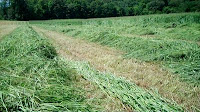
During this time we'll also be out in the fields mowing our crop down and letting it cure out some before we start chopping and filling up the wagons.


The wagons are then unloaded one at a time and blown into the silo.

 |
| Silo Unloader Raised to the Top
The first thing we have to do to get started is raise the silo unloader up to the top of the silo. This is the machine that throws out the silage when we are ready to feed.
|



The wagons are then unloaded one at a time and blown into the silo.

Finally we will let the silo unloader back down again and turn it on to feed those hungry cows!

Tuesday, February 15, 2011
Not Just A Number

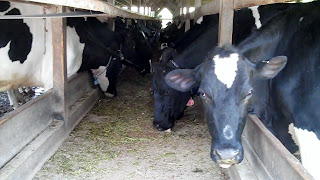
Our cows wear a number, but that does not make them just a number. We don't have a philosophical reason for not giving our animals names, for us, the number on their "necklace" suffices. With around 100 milking cows on our farm we still recognize their personality quirks. 427 only wants to eat at the end of the feedway, 65 only goes into the barn on the very last run (don't even ask her to go earlier), and 377 likes to hang out in the pasture field.
Large farms are no different. You still must have employees watching the animals to find out how they are behaving to help them reach their full potential in the herd. What is a big factory farm? I really don't know. I think any farm that takes pride in their animals and gets to know them and their needs can find success in more than just numbers.
Thursday, January 27, 2011
Antibiotics and Milk

There are always people who worry about antibiotics in the food supply, and they should when it is warranted. Recently the FDA has decided it wants to inspect milk for more antibiotics. This is in itself sounds scary, as if dairy farmers are pumping up cows with drugs and not getting caught. The truth is much different.
Dairy farmers do not want to give antibiotics at all. That goes for plain and organic varieties. If you need to give any drug it probably means the animal is sick, producing less milk, and will be costing money for treatment and lost revenue. That said, animals, like people, get sick. Sometimes you can isolate a cow, give her plenty of rest and extra attention and she will get better on her own. Other times, she may need medicine, like antibiotics, to get well.
On our farm we only give antibiotics when a cow needs them to be well. When we treat a cow that is giving milk we separate the animal from the main herd and mark her so we know that her milk should not be put in the milk tank. We then throw her milk away for the designated withdrawal time for the drug. Before we mix her milk in with the other cows' we check it with an antibiotic test kit on the farm to make sure it has completely left her system. If she still checks positive for antibiotics, we will continue to discard her milk until it is clean.
Before the milk truck driver picks up our milk he takes a sample of it to take to a lab for testing. When he takes the load to the milk plant they, too, will take a sample of it and check it for antibiotics. If the load contains any residue then the load is turned down. If the sample taken from the milk on your farm was the bad milk, then you will be responsible for that entire load. I would not want to pay for an entire load of milk. I also know some farmers that use the on farm test kit to check every tank of their milk before they even allow the milk truck driver to load it.
Wednesday, December 29, 2010
That New Calf Smell
We moved a new calf to the calf barn this morning. This is the most important time of his, in this case, life after calving. The care he receives right now will affect how he grows and how healthy he will become. We will make sure he has the right amount of milk for his growth stage every day. We will also provide fresh, clean water and hay. His stall would not be complete without having clean, fluffy straw to lay on to keep him clean and warm.
While we do not name our calves, we do give each a number so that we can keep track of them throughout their life. Keeping records about growth, weight, medicine, and management are all integral parts of raising calves.
I enjoy feeding and caring for our calves. It is a very personal thing to help nurture something all the way up to its full potential. I cannot help but feel sad when one of our calves has become ill, as all animals sometimes do. Knowing that I am responsible for each of them to stay well and grow strong is a burden I gladly bear. The future of dairying begins with each calf.
Subscribe to:
Posts (Atom)