Showing posts with label Agriculture. Show all posts

Wednesday, February 18, 2015

A Fusion Blogger Panel

Saturday I had the opportunity to do something a little different. I was invited to attend the American Farm Bureau Fusion Conference and participate on a blogger panel. Wow! Honestly it has been a while since my last prepared presentation, but when you get the chance to talk about something you enjoy to an audience that's eager to hear about it, why not?

The other two bloggers on the panel with me were Val Wagner and Katie Pinke. They blog at Wag'n Tales and The Pinke Post.

Katie, Me, and Val
Be honest, be personal, tell your story as it leads you. I think that would sum up much of the advice they had to give. When you gain the trust of your readers then you have made a real connection. Val said that you should always remember the potential of a post to gain steam long after you've written it. Katie shared how she used photos in her posts to bring readers in.

My advice was to never be boring, vary your posts, and to be social. And a good photo never hurts!

 I also got to meet some other great folks there as well. AFBF President Bob Stallman was in the hallway before our panel and spent a few moments talking with my wife and I. Meeting some of my "imaginary friends," as my wife likes to put it, in real life was nice, too.

Of course my highlight was getting to meet Janice in real life.
She's one of the first people I met on social media and a blogger that I've learned so much from.

A big thanks from me to everyone that came to our breakout panel and to the wonderful AFBF staff that made everything perfect.


Saturday, November 29, 2014

Football To Farming

If you are looking for another way that the internet can change lives then you can look no further than former NFL player Jason Brown. You see, after quitting football he did research on YouTube to become a farmer.


You can find out how to do thousands of things on the internet. In the movie The Next Three Days, starring Russel Crowe, the main character learned how to make a bump key for opening doors and other less than scrupulous skills by also watching YouTube videos.

I go to YouTube for various reasons. I want to listen to a particular song. I want to find out how to do something simple which in one case I ended up being schooled by a prepubescent boy on how to skin my daughter's Mindcraft game characters. I've posted several videos myself, too.

What have watched and learned on YouTube? Have you learned enough to want to make a major career change like Jason Brown? Or are you still watching funny cat videos?


Saturday, June 28, 2014

Drones On The Farm Part 3: Family or Factory Farm

The Farmer's Wifee and Nurse Loves Farmer are the two blogs that brought the drone campaign to my attention. I wrote earlier about privacy and expectations in Part 1 and Part 2.

What these two farmers want to accomplish is to recognize that family farms come in all shapes and sizes. Aerial photos from drones don't tell a complete story.

If you've ever looked at a medical photo...

random 8 week ultrasound
....and not been trained in the medical field you would not be able to identify much more than "I think that's probably a baby ultrasound."

How then can you tell how well animals and the environment are cared for from an aerial photo? Does our farm look bad?


Are we a factory farm? We've got a lot of buildings? We've got a lot of cows? If you think a one hundred cow dairy is a big dairy, that is. Three family members and one hired hand. We're like a machine. A four cylinder motorized factory family farm. Do the cows think they live on a factory farm? You'll have to ask them that question.


Drones On the Farm Part 2: Rights and Expectations

I wrote last in Part 1 about a Kickstarter campaign to get drones to investigate farms. Here's a link to the main guy being interviewed about his plan. Mr. Potter actually comes across as more farm friendly than the host in that he only assumes farms are guilty until proven innocent where as she condemns them with zeal. For the purpose of the interview I'm pretty sure the phrase factory farm was interchangeable with animal cruelty.

They both agreed that the drone plan to investigate farms would circumvent the so-called ag gag law and that they have the right to see everything that occurs on farms using whatever technology is available.

Rights and Expectations


While we have the right to buy things, I'm not sure we have the right to do everything this campaign wants. On the other hand, I do think consumers have certain expectations. They have expectations that when they purchase a product or service that it will be produced at a certain moral and ethical level. Different things change their expectations, for example the worries that this Kickstarter campaign's backers have in that animal cruelty is happening on farms. That lowers their expectations of food and they are either more reluctant to purchase "common" food, thereby lowering its value, and/or more likely to purchase food they perceive, whether it actually is or not, to be closer to the expectations they want. Farmers markets, Whole Foods, and Chipotle come to mind for places that appeal to consumers' higher expectations.

Farmers, and the ag community, have to work to meet consumers' expectations. In a capitalistic society producers who make the products that consumers want at the right price survive. How are farmers meeting expectations? One way we are doing it in the dairy industry is through certification. We sell our milk through a cooperative called DFA. The processors that DFA sell our milk to have expectations on how it should be produced. DFA started a third party verified farm certification process called Gold Standard Dairy in order to prove the milk they sell meets a certain level of expectations. By doing so they raise the value of all their members' milk.

But this Kickstarter campaign thinks it has the right to come on farms and if farmers don't let them they must have something to hide. There are several reasons a farms might not allow visitors. Some don't allow them because visitors bring diseases with them that could infect the animals. Others worry about liability and lawsuits. For example, our county went without a farm for a farm day tour for several years because no one was willing to risk the liability.

Another reason might be simply that like the kid that is embarrassed that his room isn't clean enough for his mom, some farms might not think their farms are "nice enough" for company. I have to admit we have some weeds and rusty machinery around that I would hate to represent our farm in photos. Maybe some farmers are simply scared of being misrepresented by those whose only goal is to make the farmer look bad. No wonder they oppose the drones.

Regulations


Farms don't get a free pass, however, if they choose not to be open to the general public. As a grade A dairy farm we are inspected by state and federal inspectors. There is no warning when they will arrive to make sure all of our milking equipment is clean and in order. Larger farms have to meet more government regulations and can be inspected by multiple government departments. 

Regulations give us the expectations that businesses are operating at a certain set of standards. While I may not have the right to walk through the kitchen of my favorite restaurant to make sure everything meets my standards, I do have the assurances that it is inspected and has a health department score sheet hanging in public view. If it doesn't meet my expectations I can choose to eat somewhere else. 

Having choices is what the free market is all about. Look at the smartphone market. You can get a phone at various price levels that have varied features and operating systems. No one is telling  Apple or Samsung to make all phones identical and to one particular set of standards because "that's the way I think it should be." No, if you don't like the way one phone is made or works, then you, the consumer, can choose to buy something else. Just like you can choose to buy grass fed beef, free range eggs, or organic milk. 

Part 3: Family or Factory

Friday, June 27, 2014

Drones On Farms (Part 1)

Imagine an afternoon when all the stars have aligned, you have completed all your work, you're alone, and have nothing to do. I know it never happens, but lets imagine it anyway. You check your doors and windows and make sure they're locked, then you yawn, and start a nice afternoon nap.

Suddenly you are awakened by a bright flash. Before you can say, "holy cheese and crackers (instead of something unprintable on this blog!)," you see a man standing in your bedroom taking a picture of you sleeping with drool on the pillow and everything. But what's more, the man is not just any man, he is part of the self proclaimed Behavior Police. He's looking out for all of us.

What offends you the most about this hypothetical?

  • Breaking and entering your house?
  • The invasion of privacy and posting of your sleeping and drooling photo on the internet?
  • The fact that he's reporting on your behavior to see if you live up to his standards?

Personal Space

We all have personal space, whether we're on a crowded bus or in our house. We have expectations about how other people interact with that. For instance, if you have a door to your house, which I assume everyone does, you would expect someone, a stranger, to knock before entering. If your door was locked you would expect it to keep them out. Let's say you have a yard of any size. Do strange people play in  your yard? No. It is your space. Like your house, other people should ask before they "play" in your yard or come into your house. 

Does that sound logical?

Drones Are All Seeing

Farms are no different than houses and yards. Farms have fences and gates and these define property lines. They define personal space for the farm. In other words, just like you should knock before entering someone else's house, you should ask the property owner for permission before going on a farm. 

Unlike people, drones can fly right over fences, and barns, and houses. They can choose to ignore personal space and property lines and courtesy. Drones are all seeing. Go ahead and ask Tom Cruise if you don't believe me.


And according to one meme making its way around the internet and the following Kickstarter group that kind of thinking is okay. They want to use drones to fly over farms to make sure the farmers are behaving correctly. They want to investigate "factory farms." Unlike most normal people, they are choosing to ignore courtesy and want to, figuratively if not literally, break down gates and fences and enter farms whenever they choose. When the police do this they have to have a search warrant or probable cause.

But obviously this group, while they are completely behind free speech, don't care about privacy, or at least other people's privacy. 

All people are not good. We have prisons to prove this. And I'm not saying all farmers are good. There are farmers that make mistakes, or do wrong on purpose just like they are people who make mistakes and do wrong on purpose in every walk of life

What I am questioning is the use of drones to spy on people and report on their behavior, and not just because someone-has-to-make-sure-people-aren't-making-bad-choices, but also for a profit (think tv promos, book deals, and speeches). Where does it go from here? Should we use drones to check up on over weight people to make sure they don't pig out on Oreo's in the privacy of their own home? Isn't it in the public's best interest that people eat healthy? Should drones sit in bathroom stalls of restaurants and report on the cooks' hand washing habits? Someone needs to make sure they don't make customers sick, right? 

Where does it end?  

Tuesday, February 25, 2014

Food Envy, Trust, and Radish Free Milk

I read a letter to the editor of my local paper last week and it really made me think about people and food.


Now I don't want to directly reply to the author of the letter because I don't know specifics about them or their medical condition, but it really made me think about the relationship some people have with food.

Food Envy

The author of the letter went from conventional food to organic to home grown. Unfortunately I think food has become the new status symbol, the new "mine is better than yours." People are going to extremes in order to prove they are buying the best (but perhaps not necessarily the healthiest) food for their family. First organic was the cool trend then natural foods. After you've done that, if you really care, then you have to buy local. Of course, your definition of local food's mileage may vary.

And what about specific foods and diets?  He's vegetarian but still eats dairy while she abstains from all dairy and chooses to be gluten free just to be on the safe side. Then there are some that only eat what doesn't kill the plant at harvest: apples, yes; carrots, no. And don't be a bonehead, go paleo. What if you were told that there were five foods to avoid if you care about the environment? Eat them and you are condemning all that we hold dear. 

I understand that some have dietary, medical, religious, or ethical reasons for their diets, but not everyone. Some are hopping on the current trendy bandwagon and now, instead of comparing who has the fancier car or clothes or jobs, we're bragging about what we are (or what we are most definitely not!) having for supper. 

Food Trust

The saddest result of this is demonstrated in the letter. The author has no faith in the food available for him to purchase. They are afraid of food for fear of what might be in it or how it was produced. This is a scary road we're going down as a result of food envy. 

Of course the marketers of food don't always do us great favors, either. How do they convince you to choose their product? One way is to differentiate on fear, like Chipotle does and has done, or like Whole Foods.

For example let's assume you have two identical gallons of milk to choose from except one of them has a label proudly proclaiming it to be "Radish Free." 
You examine them and finally say to yourself, "Heck, I don't like radishes so I better buy the radish free one." Despite the fact that all milk (and Dairy Carrie would also say ice cream) is radish free the other brands of milk now have to also label their milk as being radish free. Then when you get home you read on the internet how one man switched to radish free milk and his allergies went away, he lost weight, and he saw his libido improve. Tell me how that doesn't sound familiar? How easily we are manipulated by labels because no one will tell us any different.

The Emperor's Food Is Naked


So what happens when you mix food envy with a distrust of food? Obviously you are obligated to fix the problems with the food system. The first step is to start banning certain food production practices. You don't ban them because they are a detriment to the environment, are harmful to animals, or because the resultant food quality is poor. You ban them because their name sounds scary (like pink slime), or because you don't trust corporations (that create GMO's). It has been proven that you don't need the government to ban food practices you don't like, either. You can simply lobby a restaurant or food processor until they do what you ask. And they do. It reminds me of the story of The Emperor's New Clothes except with food. Lots of people know these practices are safe, but they would rather turn a blind eye or join in than face confrontation.

Now we have food being turned away not because it is unhealthy or unsafe, but rather because we've decided it is trendy to not eat it. Being trendy or elitist is not a good measure for developing food policy. It is like we are unilaterally cutting out certain foods or food processes with as much real sense as telling clothing manufacturers that we no longer want to buy blue shirts of any kind.

The only reason we're able to deny one particular food production method over another like this is because of our great abundance of food. I don't think many hungry folks would complain about getting some Cheerios with a microscopic amount of a GMO crop, nor would they argue about the ethical considerations of whether the beef on their plate came from an animal that needed antibiotic treatment at a time well before it entered the food chain.

I don't know that there are any easy solutions. I don't know what to tell the author of the letter above because I'm afraid they are too far down the rabbit hole to hear me even if the issues I brought up apply to them. 

There is no reason one person should claim superiority over another because of the food they eat, especially if both are choosing well balanced diets. There is no reason to use fear to make the food you choose to buy or sell to appear better than the alternative. I think consumers have to use their common sense and be wary of conspiracy theories.

I'm not against having a large variety of food choices. I think that is wonderful. I also think that there is nothing better than being an informed consumer. What am I eating? How did it get here? These are valid questions that deserve valid answers. There are great opportunities with social media to actually talk to farmers and everyone else involved in bringing food to the table. But why not leave the envy and fear at the door?

Okay, I have dropped the brush used to paint with broad strokes to the ground. I am slowly climbing down from my high horse with hands held up.

Did I miss the mark? Do you agree? Why do you eat the way you do?

Thursday, December 5, 2013

Rural By Design: How to Save Farm Land

The week before Thanksgiving I attended a meeting for PlanET and the Knoxville Metro Planning Board that hosted Randall Arendt to speak on how farms and rural landscapes can be preserved. He is a planner and author and promotes what he calls rural by design.

Typically when a developer chops up a piece of property they use it all in the simplest way possible while following local ordinances. More often than not this results in houses on large lots. If the lot buyers/homeowners hoped to move to the country the country/farmland would actually be eaten up by the house lots.

How do you plan then for new lots with houses and farmland to be side by side? Mr. Arendt's idea is that we should change the ordinances that require wide setbacks and large lots and instead make the lots smaller and closer together. Also, the most usable farmland in the piece of property should be said aside as agriculture only, and not be able to be used for anything else, thus preserving it.

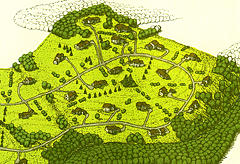
Here's an example of a conventional development by Arendt from Land Choices:

Conventional Development credit Arendt
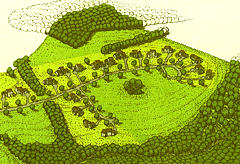
Here is an example of the same plot using conservation by design:

Conservation Development credit Arendt
The first version shows the farmland eaten up by roads and large lots. The second version shows how the same number of lots can be built and still retain much of the farmland. You can see more at Land Choices.

Randal Arendt gave several examples on how the farmland could be used including Christmas trees, horses and stables, crops, cattle, etc. He believes the property gains value by the lots being able to be a part of the rural landscape instead of eliminating it. I'm sure he could expound upon that much, much more.

I thought it was very interesting, but wondered how do you sell the idea to farmers that are in a position to sell some of their land. After ordinances are modified to allow the new densities of the properties, would landowners want to go down this road? How would the homeowners get along with the farmer creating dust when tilling the farmland that their houses surround? What about cattle that inevitably get out and walk in their yards? Would they be okay when the farmer sprays the crops with pesticides or herbicides or even fertilizers or manure?

Preserving rural land is a good thing and planning in this manner may work to do it. How would you feel about selling your land in a development like this or in buying a lot in one?


Monday, April 8, 2013

Real Factory Farming

I usually dislike the term "factory farming." No matter what type of farm you are operating caring for the animals is your number one priority if you want to be successful. As far as the dairy industry goes about 97% of dairy farms are family owned. Families, like mine, own small one hundred cow operations and families own big farms. Size really doesn't matter. What matters is how you treat your animals.

But are there real factory farms somewhere? 

I recently read an AP story about indoor farms in unused warehouses and empty factories. These farmers are growing plants under natural and artificial lights to sell. Some of the plants are grown using aquaponics, grown in water, and others by aeroponics, grown in the air.


I think it is a great idea taking unused space and creating value where there was none before. Wouldn't this be real factory farming?

Saturday, December 8, 2012

Talking With My Mouth Full

Friday I dvr'd the Today show so I could watch a story on the Hobbit movie. Little did I know that another fantasy type story would follow it with Mark Bittman fixing a pork supper. Now I, or perhaps I should say the cows, have not agreed with Mr. Bittman's opinions before and this time was no different. The pork roast and fixins looked delicious when he was finished, there is no doubt about that, but it was the comments made about the pork that I am at odds with.

He began by talking about how industrial raised pork has lost its flavor and how you can only get the best by getting sustainable, naturally raised, local pork. He went on to say that you have to buy very expensive pork for it to be any good. I didn't really need my HDTV to see him very clearly looking down his nose at me. I had just finished the leftover Boston butt pork roast my wife had purchased on sale and turned into barbecue and thought it was good. Now that I had been informed how cheap the meat was I have realized that it actually didn't taste good at all. Right.

someecards.com -

Now don't get me wrong, I want high quality food for my family, and if some production method is proven to be harmful then I don't want to be a part of it. I want quality raised animals for my family. While some people still brag about the things they own in order to feel more important, one of the newer ways is to brag about how much better your food is than theirs as in the pork example I started this with. The other way is to make you feel guilty about your food purchases.

How guilt free do you want to be in your meat purchasing? Whole Foods Market has a 5 Step Animal Welfare Ratings Standards so you can decide which purchase makes you a better person. Should you pick from #1, which is only no crates or no cages, or #5 where they are raised animal centered on one farm? Obviously the only way you can sleep at night is to choose #5, or none at all. This is not a sane way to be well informed on your meat purchases.

Maybe the food critics that are supposed to be leading us to better fortunes should focus more on how to prepare food in healthier ways that are actually tasty and affordable for regular people instead of insisting on assuaging our new found guilt by way of high dollar, pristinely raised food purchases. 

I hope I have not come across as pro this way or con that. I think there is plenty of room in the agriculture landscape for all kinds of production methods; big or small, organic or not, etc. I just don't think we should crucify one way and praise the other to the heavens. Everything has its place.

I'm climbing off my high horse now. Feel free to kick me on the way down.


Thursday, November 8, 2012

Learn How To Be A Dairy Farmer Over Lunch

I've often said if they, whoever they are, had just come to me first I could've told them how they should have done the thing they were doing. That's probably a lot of big talk and the line to my door asking for my advice has been very short indeed. This week there actually was somebody knocking and I hope the advice I gave was somewhat helpful.

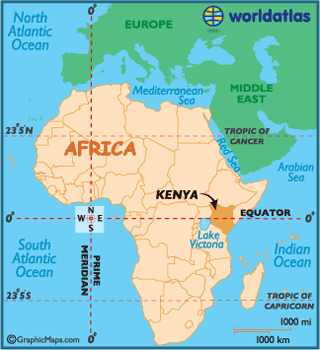
Map of KenyaThis began with a phone call from my county extension agent who asked me to meet him for lunch. Some folks had contacted him about a missionary from Kenya who wanted to know about dairy farming who I will refer to as "Ken." So, being totally motivated by the offer of french fries and a barbecue sandwich I made plans to go.

The lunch meeting consisted of my extension agent and one of his friends, Ken, and two men with the organization that are helping Ken to meet people to learn about dairy farming. Maybe I should preface the rest by saying everything I know about dairy and agriculture in Kenya I learned from Ken.

Teach A Man To Fish Equals Teach A Man To Milk?

Ken began explaining how he was college educated in what he called something like community outreach. He wanted to learn how to milk and care for dairy cattle and then teach that to the people in his community. They could then sell that milk and improve their lot in life. That sounded inspirational and like a huge project.

Ken continued by talking about how he needed to get registered cattle (meaning certified by a breed organization) and how it would take a few generations to do that. I spoke up at this point to let him know that my dairy cows are not registered and don't need to be. I sell milk and healthy strong cows that make milk are all I need and I suggested that might be a simpler approach for him to take.

He went on to describe how each family's goal would be to have up to a dozen cattle to milk. We then began asking him about breeding the animals because I reminded him that cows have to have a dry period of no milking while they are pregnant and if they are never bred they will eventually stop producing milk. Ken wasn't aware of that and perhaps that was the first clue I had of how big a hill he was trying to climb. I offered that the families could buy/rent a community bull to service all the animals as needed. A simple approach, I hoped.

Feed and Milk Processing

We asked Ken about available feed for the animals. He said that Kenya was in a warm climate and that he had been feeding his one cow and calf dried corn husks and some other plant from what I gathered was a grocery type store. He also picked leaves from a native plant. When we inquired how the community would feed their animals he said the children could pick leaves so they could do their part. Wow, that was going to be many leaves to keep just one animal going. Cows need lots of feed and forages in a well balanced diet to produce milk. Without good nutrition they are not going to make much at all. We suggested that some families might earn their money by growing and harvesting crops for the animals.

When asked about processing the milk Ken said there was a processing plant nearby that you could take your milk to and they would pasteurize it and give you a portion of it for yourself to drink and a small price for what you sold them. Questions we thought he should ponder were how to get the milk there in bulk quantities as well as how to ensure food safety when in storage and transport. 

Man on a Mission

Sunset in Kenya
Ken was excited to meet and talk with us and get more questions answered. The best suggestion the group gave him was to work on a dairy for at least a week, if not a season or so. Hands on training with animals and milking is probably the best way to understand how to do it. Unfortunately Ken had to return to Kenya almost immediately. I told him something I would never imagined myself saying just a few years ago: go look on YouTube. You can find examples of practically anything on dairy farming there from milking to forage production. It wasn't a perfect solution, but in this case I hoped it would be of some use. 

Will he be able to implement his dream of helping his community by teaching them how to care for dairy cattle and become dairy farmers? I don't know. Did I teach him how to be a dairy farmer over lunch? Definitely not. He's got a very long row to hoe, but I think he really wants to make a difference and I wish him well on his pursuit.

map


Tuesday, July 17, 2012

Conversing With Famers

Whenever I am in need of an icebreaker to start a conversation around some new people I tell them that I am a farmer. This usually elicits many questions on the weather, crops, and animals. I think there are many people who are genuinely interested in how their food and fiber makes its way from the farm to them.

Starting a dialogue just as I've described is exactly what the U.S. Farmers and Ranchers Alliance are trying to enable. They recently gathered a diverse group of farmers, including my friend David Foster, and consumers to meet over breakfast. What could be a better time to talk to farmers than with food?

You can read about this breakfast on the blog Eating Bender: A Conversation with Farmers and Ranchers. Jenn writes about her experience meeting the folks that are out there in the world of agriculture.

Friday, March 2, 2012

Hanging Out With YC's

young cooperator

It is nice to get away from the farm once and a while, and even nicer to hang out with fun people. The last two days I attended the Dairy Farmers of America's Southeast Area Young Cooperator Steering Committee Meeting in Knoxville. While planning for our summer event it was fun to interact with other young dairy producers and share our victories and losses, our goals and dreams, and tales of working with family.

On the second day we had the opportunity to tour the new University of Tennessee dairy facility. It is a researched based farm meaning while there is a regular herd being milked, there are also groups of cows going through different studies. One of the main research goals of the farm is to determine the environmental impact it has on the area. Mr. Charlie Young gave us a great tour and overview of how the operation was working and how he hoped the knowledge gained there would be for the benefit of other producers.


Saturday, February 4, 2012

Just Talkin' Farm Work

Lots of things happening on the farm this week. The one I'm most proud of is that we finally got one group of calves moved. We have different fields for different sized animals. As they move up in size we move them to the next field. We have been on the receiving end of much rain lately and it has been too muddy to move them with our trailer. This week it dried out and we could finally check that off our to do list.

As spring gets closer our silage supply gets lower. This photo was taken inside of our 20 foot by 70 foot silo. About once every 10-14 days we have to lower the silo unloader to the next window like I did this day. We still have a bit of it left and hopefully enough until it is time to chop our winter wheat. In the meantime we are supplementing the cows diet with some really good lookin' leafy green hay we purchased.


I finished out the week with an off farm trip to a Tennessee Farm Bureau District Kick-off Meeting. Farmers gathering together to support one another and working together to bring a voice to consumers and legislatures alike; what a great organization to be a part of.

One of the interesting things discussed at the meeting was the new child labor law. I believe that farm work provided the discipline I needed as a child to make me a better person as an adult. I would hate to think that laws could be passed that might hinder me from providing that same opportunity to instill those values in my own children.

Saturday, January 28, 2012

My Coveralls

brown coveralls
Much Cleaner Than Mine
They say you can tell a lot about a woman by the contents of her purse. The make up she has, the type of wallet, her phone, the fact that it has diapers and wipes or not, all tell something about her. Perhaps you can tell a lot about a farmer by the contents of his coveralls.

This morning I finally made it to the washing machine before my wife and was able to put my coveralls and coats in. Before I could do anything I had to make sure the pockets were all empty. In no particular order here's what I found.

  • A pocket knife. You can't go to the farm without one.
  • Twine Strings. Many uses for these, like a poor man's duct tape.
  • Fence Steeples. Because you never know when you'll find a fence in disrepair.
  • An uncracked pecan and some chocolate wrappers. Because you might get hungry out there doing all that fencing!
  • A 9/16's wrench I forgot to put back in the toolbox when we worked on a silage conveyor.
  • A pair of gloves that were very dirty and needed to be washed, too.
  • Grain, hay, and other bits of trash that can't go in the washer!
I'm not sure what the contents of my coverall pockets say about me. I'm just glad I have a pair to wear on cold days on the farm.

Friday, October 14, 2011

The Quiet Solitude of Farm Life

heifer eating grain

Working with animals and being outside are some of the things I enjoy most about farm life. Growing up I can't say that I fully appreciated the gift I had of living on a farm.  That isn't at all to say I didn't enjoy it.  I spent my time working with the calves and cows, in the fields, hiking around with my Grandmother, and exploring with my cousins.  My childhood was defining me at the time, but I didn't know it yet.

Being in college was the first time I had been away from farm life on a regular basis. Concrete, noise, and papers seemed to go on and on.  The opportunity to go home on the weekends and work on the farm was what kept me grounded.  That was when I realized the importance of green spaces and parks in towns.  Connection.  I mean I knew that land should be set aside for nature just for nature's sake, but I didn't recognize our need for being in nature.  

I can't imagine not being on the farm everyday.  Whether it is the quietness of feeding the heifers out in the pastures or working in the fields on the tractor, there is something undeniably honest about farm life.


Saturday, September 24, 2011

Talking

Thursday on my lunch break I watched the first panel of the U.S. Farmers and Ranchers Alliance's Food Dialogues.  I thought it was a great opportunity for the ag community and consumers to start an open conversation about what expectations they have of each other while sharing thoughts and questions.  Two great posts about the entire town hall can be found at Common Sense Agriculture and Cause Matters.  While I didn't get to watch it all I did think about the concept of it while I was on the tractor that afternoon.

To achieve success a business must produce a quality product that the consumer will want to purchase.  The ag community has to do the same.  Consumers also must have reasonable expectations for the products they want.  A desire for specific production methods may not be feasible for anyone on any level.  But where should the products and the consumer cross paths?

I like to think that I fall in the "do what you love and you'll never work a day in your life" camp, but I still have to make money to take care of my family.  The one thousand cow dairy and the man that is selling veggies from his garden at the farmers market are the same.  At the end of the day they have to make a profit because they cannot do it for free.

Dialogue was the purpose of those town hall events.  I don't know if they achieved that goal, but I do know they made a start at it.   I think farmers need to convey how and why they do the things they do.  When 100% of the people use agriculture products maybe everyone needs to listen.

Monday, May 16, 2011

Farmer Jed Syndrome

farmer jed

A recent article in the American Farm Bureau newspaper made me think about what I call the "Farmer Jed Syndrome."  The report was on a survey by the Kentucky Farm Bureau that revealed out of 551 shoppers at farmers markets 54% said that farming is worse than in the past and cited factory farms and the loss of the family farms as contributing factors. The Ky FB president, Mark Haney, went on to say that "people in general are unaware that family farms account for more than 90% of our farms."  

The Farmer Jed Syndrome is how I describe the disassociation of the consumer to their food.  I think many people have the idea that agriculture should look just like Farmer Jed in a Little People playset, no different than Dorothy's family farm in The Wizard of Oz.  

wizard of oz
Toto, we're not in the 1930's anymore

Just like the cell phone you carry today is much more sophisticated than the large bag type cell phone that was carried twenty years ago, farming technology has changed. Today through innovations in nutrition we can feed cattle a balanced ration through each stage of their growth and production.  Their health and milk production can be monitored with computers to better evaluate their status (a great video example of this in action on a dairy farm).  Studies from ag extension services have helped us better understand cattle handling techniques and housing.  Vaccines are now common place to keep our animals healthy.  Advances in genetics have helped eradicate unhealthy traits in cattle and improve on good ones.  The farmer of today produces twice as much as the previous generation and uses less land, water, and energy.  Dairy farming has changed a lot since Dorothy went to Oz.

I've always thought of our farm as a small family farm.  I'm often asked how many cows do we milk.  When I reply around 100 they usually reply with that's a lot.  I've never thought it was especially when I compare myself to some neighboring farmers who milk several hundred.  Another farmer with less than fifty head of cattle might think I'm big.  No matter what size a farm is there is one thing they all do the same and that is care for their animals.  If that farmer with thirty cows doesn't pay attention to them and treat them well he won't be farming long and that is no different for the big dairy.  Making sure the animals are healthy and happy will make them productive and that is the goal of every dairyman.

"The rule to be observed in this stable at all times, toward the cattle, young and old, is that of patience and kindness. .......Remember that this is the Home of Mothers. Treat each cow as a Mother should be treated. The giving of milk is a function of Motherhood; rough treatment lessens the flow. That injures me as well as the cow. Always keep these ideas in mind in dealing with my cattle."--William Dempster Hoard

Wednesday, April 13, 2011

Hats

dairy farmer caps


Some of us have a lot of hats that we wear.  Mine, in no particular order, include father, husband, son, friend, farmer, and a few more.  Wearing the right hat at the right time is not always an easy task.  While many people can indentify with some hats I wear there are less than 2% of the population that wear a farmer hat like me.

I went to town to do some non-farm business the other day and as usual I was wearing a farm hat and coat.  While waiting on some paperwork the sales clerk began asking about what kind of farming I do and reminiscing about her own childhood farm memories.  Unfortantly for me I was focused only on me and missed a great opportunity to spread the good news about milk.  I forgot my hat.  A few days later I was again in town and fell into the same situation.  This time I was pro-active and talked about dairy farming and the ways we provide safe wholesome milk with happy healthy cows.  I was proud of the hat I was wearing.

Wednesday, March 9, 2011

Grandma Was Right

dairy cows eating


I was conversing the other day with another farmer on why he sometimes doesn't  know why he does what he does for a living.  I replied back with something positive and he responded with how it had been one of those days.  What was bad about it?  Maybe that piece of machinery that needed to last until fall gave out, if it wasn't for bad help he wouldn't have any help at all, or that favorite cow was having trouble.  It doesn't matter, we've all had one of those days.

It made me think about why I farm.  Before she passed on my Grandmother said, "If you like farming, there's no better life to have."  And you have to like it to make it work.  You have to like getting up every morning rain, snow, or sunshine and taking care of the cows. You have to like it when feed and fertilizer start costing more than you bring in.  You have to like it when it doesn't look like your crop will get enough rain and then watch in awe as it grows tall and strong.  You have to like it when the baby calf you had to pull during its birth has now reached maturity and is having calves of her own.  You have to like it when you see the milk flowing through the pipelines into the milk tank and knowing you are providing a most wholesome food for people everywhere.

Oh, I've definitely had those days myself when I wonder about what I do.  Then I think about the simple and honest work I get to spend my days doing and I know I wouldn't trade it for anything else.  My grandmother was exactly right.

Friday, February 25, 2011

Calves Vs Babies

baby dressed like cow
baby calf

VS


While changing my 2 month old son's diaper the other day, I thought to myself that I never have to do this to calves.  And then I really started running with that thought until I came to this train wreck...

So with the help of his older sisters here are

The Top 10 Reasons Why Calves Are Better Than Babies

1. While you may get up to feed them hungry calves do not wake you up at night.
2. When you take them on  a trip you don't have to put the calf in a "calf seat."
3. You can legally sell a calf.
4. You never have to fear a calf crying in a movie theater, restaurant, or plane.
5. When you vaccinate a calf you can put it in a head chute.
6.You never have to burp a calf.
7. Calves do not need to be rocked to sleep.
8. You do not have to dress a calf.
9. Calves do not need any toys to play with.
10. You don't have to change a calf's diaper.